Getting Started
Prediction-Based Inference: Methods & Applications
Build intuition for prediction-based inference by simulating data and comparing different methods.
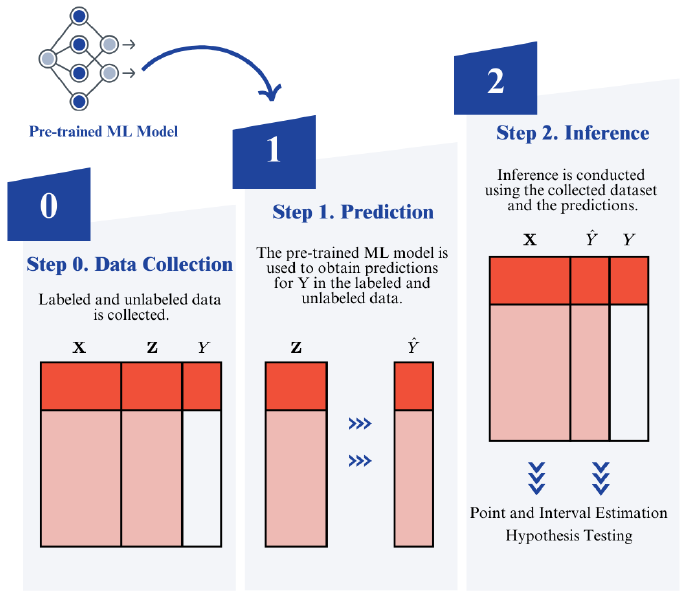
What do we do after we have machine learned everything?
Learning Goals:
ipd R package.Learning Objectives:
ipd::ipd() to continuous and binary outcomes.| Activity | Time |
|---|---|
| Overview | 35 m |
| Short Break and Q&A | 15 m |
| Unit 00: Getting Started | 30 m |
| Unit 01: AlphaFold | 30 m |
| Wrap-Up and Q&A | 10 m |
The companion website for this workshop is available at:
https://salernos.github.io/ipd-workshop
To use the workshop image:
docker run -e PASSWORD=<your_chosen_password> -p 8787:8787 ghcr.io/salernos/ipd-workshop:latestOnce running, open http://localhost:8787/ and login with username = rstudio, password = <your_chosen_password>
Then begin!
In this workshop, we explore the consequences of conducting inference on predicted data across several applications and present a suite of prediction-based (PB) inference methods that adjust for prediction-related uncertainty to improve inference validity and efficiency. We also introduce ipd, a user-friendly R package that implements the PB inference methods through a unified interface. The package supports modular integration into existing workflows and includes tidy methods for model inspection and diagnostics.
This workshop covers two modules, each illustrated with the ipd package:1
We have also included some supplemental modules for you to explore on your own:
This workshop uses a blended format of instruction and hands-on coding exercises. Participants should:
R and tidyverse syntax (e.g., dplyr, broom).randomForest) and regression modeling (e.g., lm, glm).ExpressionSet, AnnotationDbi, and MLInterfaces is helpful for one of the supplemental modules.Presenters: Jesse Gronsbell ✉︎, Jianhui Gao ✉︎, Stephen Salerno ✉︎
All Contributors (Alphabetical Order): Awan Afiaz ✉︎, David Cheng ✉︎, Jianhui Gao ✉︎, Jesse Gronsbell ✉︎, Kentaro Hoffman ✉︎, Jeff Leek ✉︎, Qiongshi Lu ✉︎, Tyler McCormick ✉︎, Jiacheng Miao ✉︎, Anna Neufeld ✉︎, Stephen Salerno ✉︎
Module card cover images were generated by GPT-5.2.↩︎